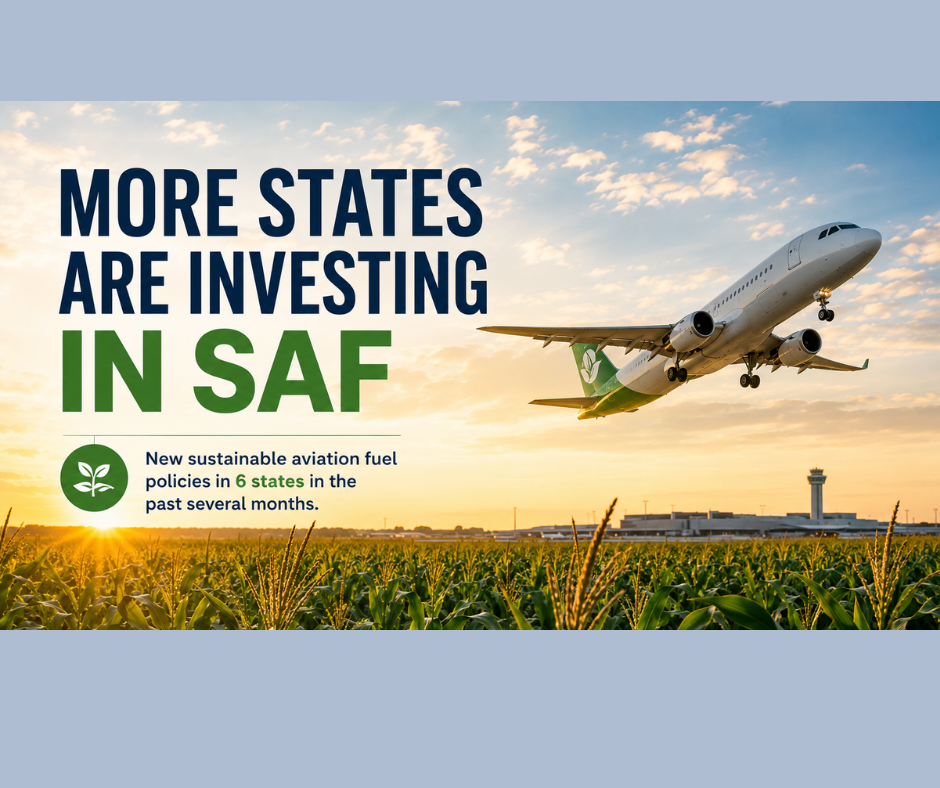
Over the past several months, one thing has become increasingly clear: states aren’t waiting for Washington to act on sustainable aviation fuel (SAF).
From tax incentives to production credits, legislatures across the country are adopting policies designed to grow domestic SAF production, attract private investment, strengthen agricultural markets, and position their states to compete in one of the fastest-growing energy sectors.
The message is unmistakable: SAF isn’t a future opportunity—it’s an opportunity states are investing in today.
Six States Leading the Way
Colorado
Colorado recently approved legislation creating a sustainable aviation fuel purchase income tax credit. The law also provides an additional incentive for SAF that is both produced and purchased within the state, encouraging local production while helping airports reduce emissions.
Georgia
Georgia expanded major tax incentives for forestry manufacturers, including biofuel producers utilizing Georgia-grown feedstocks. The legislation reinforces the state’s commitment to growing a domestic renewable fuels industry while creating new opportunities for agricultural producers.
Kentucky
Kentucky established a tiered SAF production tax credit benefiting both SAF producers and feedstock suppliers. The legislation also includes an airport sales tax rebate designed to encourage airlines to purchase alternative jet fuel within the state.
Massachusetts
Massachusetts approved a tax credit for sustainable aviation fuel used on flights departing from airports in the Commonwealth. The policy is intended to strengthen the state’s position as a regional hub for sustainable aviation fuel adoption.
Minnesota
Already a national leader in low-carbon fuels, Minnesota expanded funding for its SAF tax credit program and extended the incentive through 2035, providing long-term certainty for investors and producers.
Wisconsin
Wisconsin made sustainable aviation fuel projects eligible for Enterprise Zone tax credits, authorizing up to $120 million in incentives for a facility producing SAF from Wisconsin-sourced wood feedstocks.
Why This Matters
These policies are about far more than aviation.
Every new SAF incentive represents new demand for American-grown feedstocks, greater opportunities for farmers, increased investment in rural communities, and stronger domestic energy production. As airlines look for ways to meet sustainability goals, states are recognizing that agriculture can be a key part of the solution.
For corn growers, ethanol producers, and rural America, the growth of the SAF market represents an opportunity to diversify demand while strengthening America’s energy independence.
The Momentum Is Building
Taken individually, each of these state actions is significant. Together, they paint a much bigger picture.
Across the country, policymakers are signaling confidence in sustainable aviation fuel as an economic development tool, an agricultural opportunity, and an energy solution. Investment is following policy, and demand continues to grow.
Congress Should Keep Pace
State leadership is encouraging, but unlocking SAF’s full potential will require durable federal policy.
A stable, long-term extension of the 45Z Clean Fuel Production Credit, regulatory certainty, and continued support for lower-carbon agricultural practices will help ensure American farmers, ethanol producers, and rural communities are positioned to supply the growing global demand for sustainable aviation fuel.
The momentum is already here. The question is whether federal policy will keep pace.